



North America’s far northern routes are legendary, but few match the Dempster Highway’s combination of beauty and brutality. Stretching 457 miles from Yukon to the Northwest Territories—and continuing to the Arctic Ocean—this iconic gravel road tests vehicles and drivers alike. From winter’s deadly cold to summer’s tire-shredding rocks, the Dempster demands respect while rewarding adventurers with unforgettable remoteness and natural splendor.
North America’s far northern routes are the things of legend. Winding hundreds of miles across northwestern Canada and Alaska—with some past the Arctic Circle—these remote corridors are iconic, irresistible driving destinations for adventurers.
While they have highway numbers, they’re often known by other names: The Klondike, The Dalton, The Cassiar, and The Dempster. I’ve driven all of these with my navigator, photographer, and wife, Mercedes, in the passenger seat.
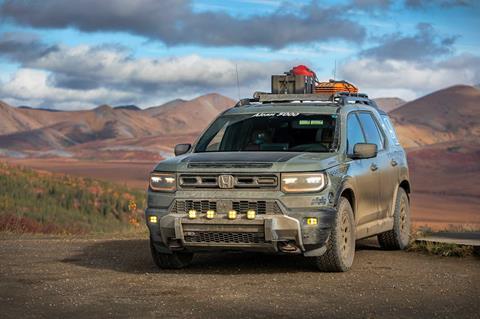
Each road has its own charm, its own mystique, and its own dangers. We’ve been up the Dempster twice on the Alcan 5000 Rally; once in the winter to the Arctic Ocean (in our JDM 1991 Mitsubishi Pajero), and once in the summer to the Arctic Circle) in a 2026 Honda Passport TrailSport.
This rowdy route is full of beauty, challenge, and adventure, and can be one of the world’s most grueling drives.
Where is the Dempster Highway?
The Dempster Highway starts about 25 miles west of Dawson City in the Yukon Territory (YT) and intersects Klondike Highway (Yukon Highway 2).
Also known as Yukon Highway 5/Northwest Territories Highway 8, it extends 457 miles northeast to Inuvik. Drive another 94 miles north on the Inuvik Tuktoyaktuk Highway 10 (sometimes considered part of the Dempster), and you’ll reach the Arctic Ocean at Tuktoyaktuk.
Dempster Highway History
The Dempster loosely follows an old dog sled route from Dawson City, YT to Fort McPherson, NT. It’s named after Corporal William Dempster of the North-West Mounted Police.
The road’s construction began in 1958 to serve newly discovered oil fields. After 20+ years of construction, it officially opened in 1979. The road from Inuvik to Tuktoyaktuk (“Tuk”), however, didn’t open for year-round transportation until 2017.
Winter or Summer: Different Personalities
In February 2020 we drove the Dempster all the way to Tuk. It was a slog. We had blizzard conditions, glare ice, snow drifts covering the road, and temperatures of nearly -50° F.
After passing Eagle Plains, the Dempster’s halfway point, the road closed behind us. From whiteouts to wipeouts, we saw it all, although we never saw an inch of bare road, just snow and ice. We witnessed caribou, arctic fox, ptarmigan, and even a wolf. Driving the Dempster in the winter puts survival first and everything else second.
While the weather isn’t trying to kill you in warmer months, the road still isn’t easy. The route is actually harder on vehicles without snow. In the winter, cracks and potholes are filled in with snow and ice making it smoother. But without snow, the Dempster can be a minefield of road hazards waiting to do damage.
Highway Hazards: Flat Tires, Truck Troubles, Rough Roads, & Semis
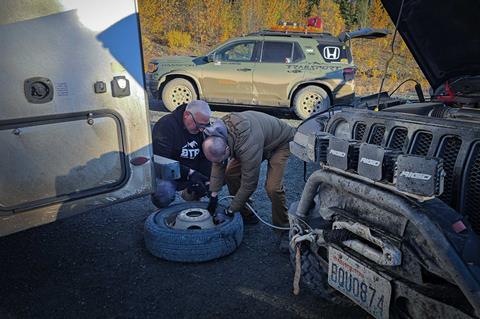
When we drove the Dempster to the Arctic Circle in September, 2025, we ran into three vehicles with flats. This included German tourists with double flats on a rented RV.
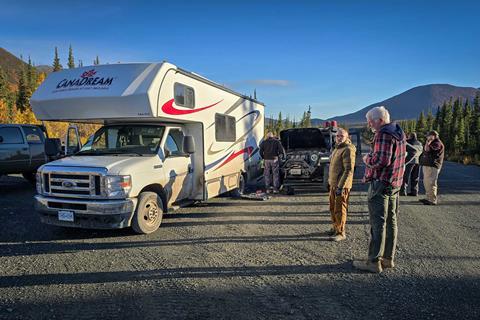
We, along with others in our group, helped switch the RV’s single spare, and patched another with two plugs. Mercedes’ fluent German also came in handy, as the RVers didn’t speak English. But in this remote part of the world, when someone breaks down, you stop—it’s not up for debate.
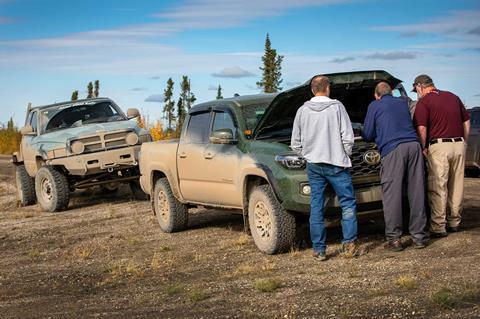
We also stopped for a young couple traveling from Inuvik to Dawson City in a Toyota Tacoma with electrical issues. I took out my voltmeter and several of us started to diagnose the problem. It turned out to be a bad fuse, and we got them on their way. Again, you always stop for stranded motorists on the Dempster.
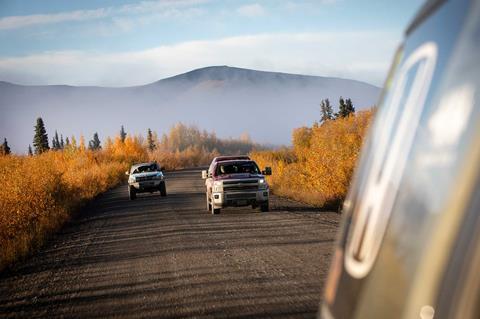
The Dempster is mostly dirt and gravel with sections of small rocks that makes the ride rough. Road graders do their best to keep the highway in good shape, but it’s a never-ending Battle Royale between graders, Mother Nature, and the heavy-haul semitrucks which rule this road.
Those behemoths transport everything from oil and infrastructure equipment, to food and supplies for villages, and they’re the top dogs year round. If they’re going slowly, they may let you pass; they may not. It depends on what’s ahead.
Even though they may seem like rolling roadblocks, they demand and deserve respect. They traverse this dangerous road for a living. Give them a wide berth and be careful and courteous when passing.
The Halfway Point: Eagle Plains
Halfway up the Dempster is Eagle Plains, population 8. It’s one of the most remote locales in Canada. You’ll find expensive fuel, a mechanic, food, and 32 rooms of lodging. But this isn’t a Holiday Inn; it’s primarily a fuel depot with some amenities.
Don’t pass Eagle Plains without fueling. It’s the only place to get it until you arrive towards the top of the Dempster at Fort McPherson. So, fill your rig and fuel cans.
It’s also not a bad place to fill your belly (the nachos weren’t half bad). Fun Fact: 14 miles north of Eagle Plains, the Dempster is also Wiley Airstrip (CAJ2). Watch for aircraft!
Amazing Natural Beauty
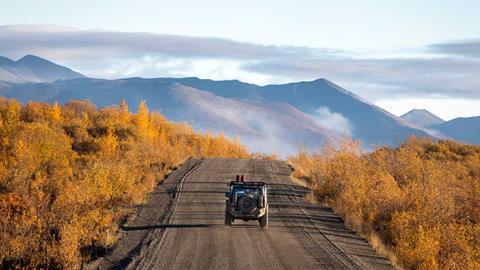
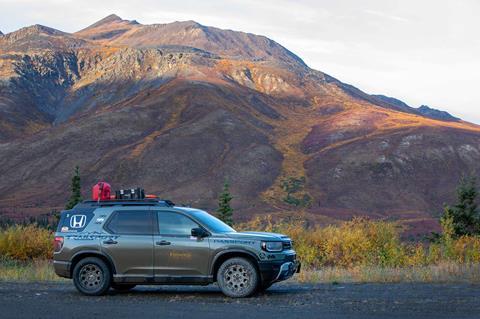
While the Dempster is grueling, its natural beauty matches its rugged fervor. In winter, the entire landscape looks like it’s covered with wedding cake frosting; smooth and perfect like a layer of white fondant. In autumn, the fall colors are in full force, showcasing yellow, orange, brown, and maroon hues across the hills and flatlands.
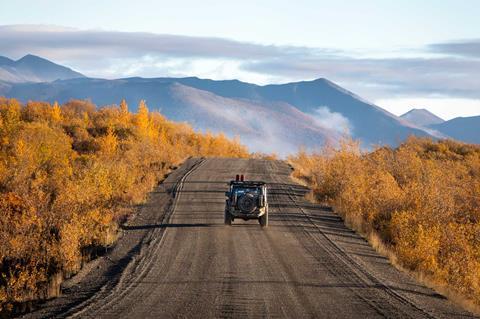
The southern portion is hillier with trees and valleys. Maroon colors look like an exotic carpet covering the earth’s curves. Hints of yellows and browns add ornamentation creating incredible natural beauty—a wild northland paradise.
Arriving at the Arctic Circle
The Arctic Circle passes eight countries, including Canada, and you can visit it on the Dempster in the Yukon.
This location is a dichotomy: It’s a small sign and a couple of outhouses—not much there. Conversely, you’re at a very exclusive point on the earth few people visit.
Visitors have tacked up signs and slapped stickers on the actual Arctic Circle marker; the aforementioned outhouses are the unfortunate recipients of graffiti. Yet it’s one of only a handful of Arctic Circle stops on a road anywhere in the world.
And if you’re curious, yes those outhouses are open in the winter. I don’t suggest you take seat—you may get stuck to it.
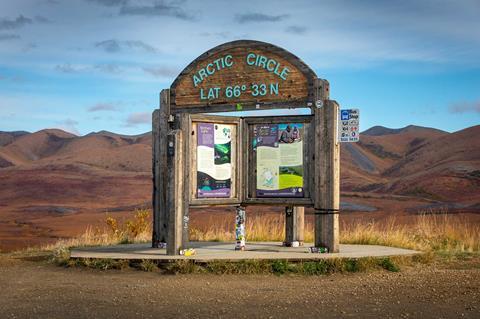
It’s 204 miles from the Arctic Circle sign to Inuvik, or roughly 5 hours and 15 minutes according to Google Maps, and 7 hours and 35 minutes and almost exactly 300 miles to the Arctic Ocean in Tuktoyaktuk.
Things To Bring
If you opt to venture up the Dempster Highway, I strongly recommend a few things. First, have a full-size spare, an air compressor, and a tire patch kit (and know how to use all three).
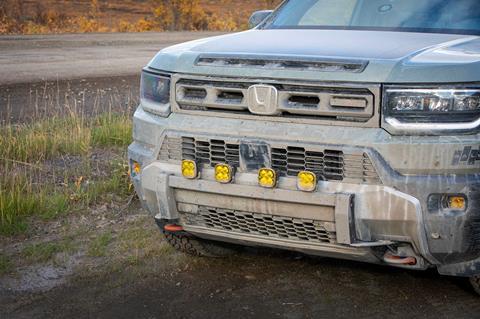
Bring an extra fuel can or two, a set of traction boards (just in case), and equip your vehicle with auxiliary lights for low-light/low-visibility situations. We ran Baja Designs Squadrons on our 2026 Honda Passport TrailSport in 2025.
And, just in case, I recommend a satellite device, such as a Garmin inReach device as there won’t be mobile phone service in most places. It could be a lifesaver in an emergency.
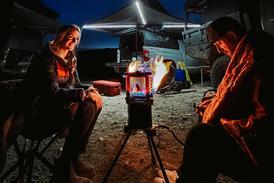
Also bring extra food, water, and warm clothes. In the winter, add an insulated water vessel, a properly rated sleeping bag, a camp stove, with proper fuel (when it’s too cold, propane won’t work) and other things that’ll prevent you from potentially, you know, freezing to death.
An Incredible Adventure
Driving the Dempster Highway assures adventure. This road requires concentration and demands respect. Sometimes it tries to kill you. Other times it rewards you with unique beauty. In the snow it’s treacherous at best. In the rain, it’s a muddy mess.
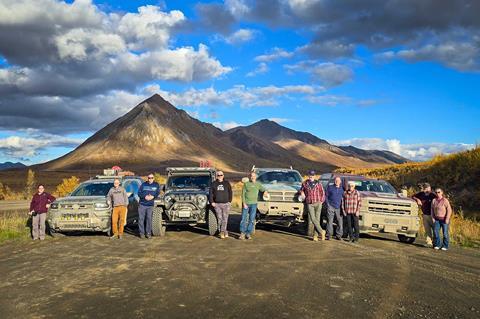
When dry, it can be rough and dusty. But one thing’s for certain—you’ll never forget it. If you’re like us, its allure is magnetic, and you’ll want to return. We’ll be back in September of 2026 as we compete in our fifth Alcan 5000 Rally competition.
Access More Great Stories!
For more informative articles like this, consider subscribing to OVR Magazine in print or digital versions here. You can also find the print edition of OVR at your local newsstand by using our Magazine Finder.




No comments yet