




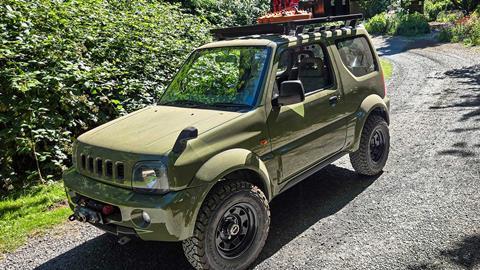
The third-gen Suzuki Jimny was a bucket-list 4x4 we could never buy new in the U.S. Thanks to the federal 25-year import rule, we tracked down a 1998 JDM Jimny Wide, sorted its quirks, and built it into a pint-sized overlander loaded with quality gear — and it’s just getting started.
Mighty and Mini: JDM 1998 Suzuki Jimny Wide
A third-generation 1998–2018 Suzuki Jimny has long been a bucket-list 4x4 for us. One problem: it was never sold in North America. But a few years ago, they became eligible to import into the United States under the federal 25 year rule.
Not one to back away from an automotive promise, in 2025 we got a Japanese domestic market (JDM) 1998 Suzuki Jimny Wide. But before we get to our Jimny, here’s a brief history lesson.
Why Didn’t The Suzuki Jimny Get Sold In the USA?
Suzuki entered the North American automotive market in 1985 with the 1986 Samurai, essentially a Jimny variant. It had body-on-frame construction, a two-speed transfer case, and solid axles, would be cheaper than the soon-to-debut Jeep Wrangler YJ.
It sold exceptionally well until the infamous Consumer Reports rollover debacle in 1988 in which the publication deemed the SUV a rollover risk. Sales tanked, and by 1996 the Samurai disappeared from the US market.
Suzuki sued Consumer Reports in 1996, and in 2004, Suzuki and Consumer Reports settled out of court. Despite selling cars for nine more years, Suzuki sales never recovered, and the brand left the North American market in 2013.
In 1998, Suzuki introduced a new, more modern, refined Jimny to the world, North America excluded.
This third-gen Jimny gained coil springs, new sheet metal, a more refined interior, yet retained the body-on-frame construction and beloved solid axles.
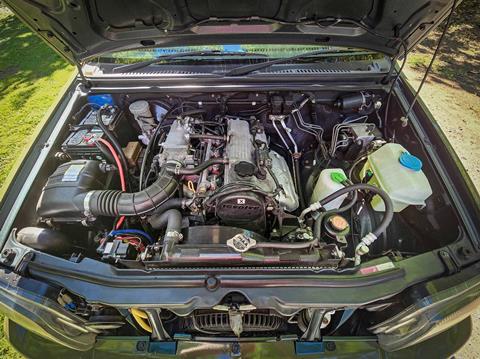
Globally, the J33 Jimny (or “Jimny Wide” in Japan) debuted with the G13BB, a SOHC 1.3-liter naturally aspirated four-cylinder engine that made 80 horsepower and 88 lb-ft of torque. (This is actually the same mill found in the 1998–2001 Chevrolet Metro/Suzuki Swift in North America).
It had an athletic shape with bulging fender flares. Japan also got a narrower kei version of the Jimny (no fender flares), the JB23 which had a DOHC three-cylinder 660cc turbocharged engine making 63 horsepower and 70 lb-ft of torque.
All 1998 Jimnys could be had with a five-speed manual of four-speed automatic transmission. We bought the manual transmission variant.
Finding Our Third-Gen Jimny
Like so many of us, I constantly cruise Facebook Marketplace for vehicles and parts. I started thinking about Jimnys for some reason and started looking at what was available.
We can’t register kei cars in Oregon (yet), so the 660cc Jimny was never an option. Unfortunately, the 1.3-liter Jimny Wides are harder to come by than the JDM kei models.
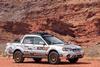
Eventually I found one for sale from a private owner in Puyallup, WA and we went to go look at it two days before we left for our TransAmerica Trail effort with a customized Subaru Crosstrek Wilderness.
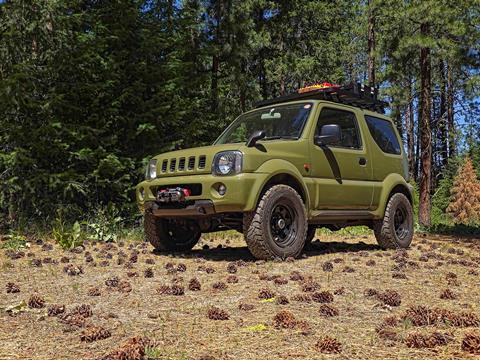
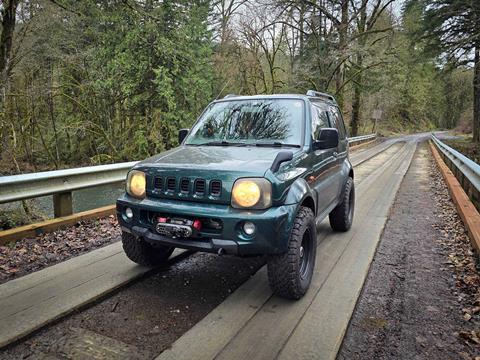
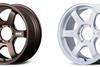
The owner had taken good care of it during his short tenure with the vehicle. He’d added a host of aftermarket goodies including a winch mount, front recovery points, and 15x7 (et 0) wheels from UK aftermarket company, Jimny Bits.
It also had AVM manual hubs, a 1” lift on King Springs, and aftermarket shocks. The clincher? It came with new 235/75R15 BFGoodrich All-Terrain KO2 tires. The icing on the cake was a whole slew of hard-to-get replacement parts included in the price. SOLD!
The Drive Home and Required Maintenance
With the deal done, we hopped on Interstate 5 south for 150 miles. The little 1.3-liter engine was surprisingly happy at 65 MPH.
However, when I pulled into our driveway, Mercedes hollers, “It’s smoking!” I cut the engine and got ready to play the game: Steam or Smoke?
As she ran for a fire extinguisher, I popped the hood and smelled burning oil. I saw it dripping onto the exhaust manifold. That answers that.
I bought a G13BB front crankshaft seal at my local auto parts store along with a timing belt, water pump, and tensioner.
All those things fit this JDM Jimny (remember, this is the same four-banger mill as the Metro/Swift), except the water pump. (Turns out the Jimny pump has the tensioner in a different position.) Our mechanic threw the old water pump back on (it only had 45,000 miles on it).
Then I discovered a coolant leak. I ordered all the rubber hoses from Japan (as well as a backup water pump), and installed them, eventually fixing the leak.
And, like many older vehicles, I had a sticky front caliper. I cleaned everything up, regreased the slide pins, slapped new pads on, and it’s as good as new.
With the maintenance done, it was time to start building up this downsized rig.
Getting Good Recovery Gear
The first thing we added was a Warn R60-S winch with a 6,000 lb. capacity; a product I recently wrote about. To it, I added a Factor 55 UltraHook XTV and Short Drum Comp Fairlead.
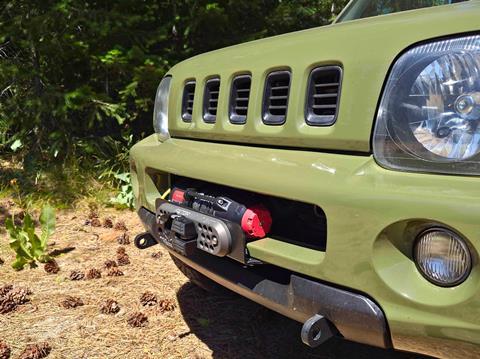
Having previously worked at Warn and alongside Factor 55, I know and trust their recovery gear, and it was a no-brainer to upgrade.
We also carry Factor 55 shackles, snatch blocks, and other recovery gear.
A Tire Trade: BFGoodich KO2 to KO3
Putting 235/75R15 tires on a third-gen Jimny is like putting 37s on a Jeep Wrangler: They might fit, but they might rub. Indeed, the 235s rubbed at full lock and under articulation.
To remedy this, we switched to a 215/75R15 and went from KO2s to BFGoodrich’s newer KO3 tires.
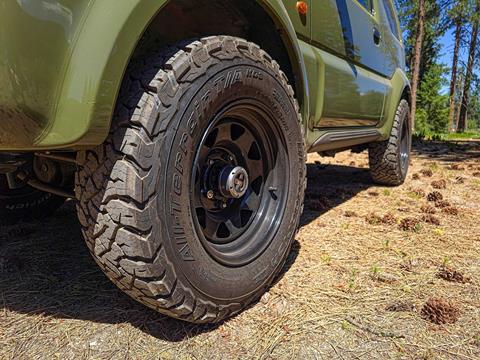
Not only do we get better wet traction and wear with the KO3s, but the smaller size solved our rubbing problem, made the Jimny more drivable, and we reused the 15x7 steel wheels.
While we lost 1.2” of clearance under the axles, the smaller tire size’s pros outweighed the cons.
A Roof Rack = More Range
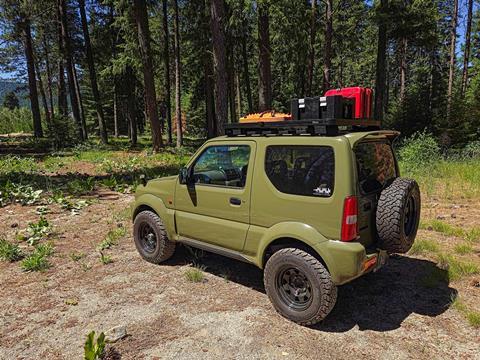
Our Jimny Wide has a tiny 10.6-gallon (40 L) fuel tank. This means frequent fill-ups and not much range. Adding a roof rack would give us the ability to not only carry fuel, but other items, too.
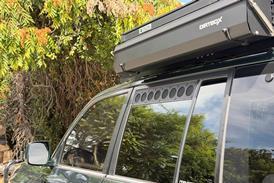
Front Runner Dometic has a Jimny-specific Slimline II rack for the ’98–’18 models. We contacted them and got the rack for our mighty but little green machine.
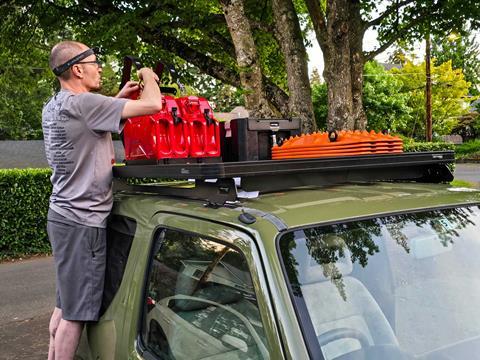
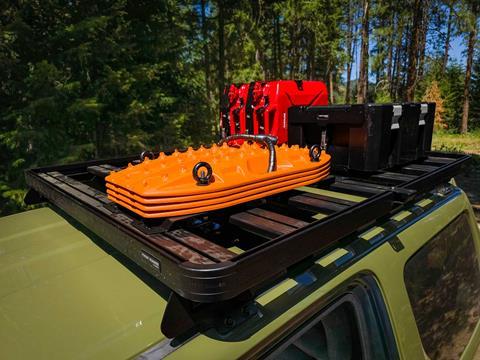
In addition, we got a Double Jerry Can Holder, a Wolf Pack Pro mounting bracket, and a Recovery Device Mounting Kit for traction boards.
Between these three accessories, we could carry 10 more gallons of fuel, affix a Wolf Pack Pro box for more storage, and have a place for our MAXTRAX Minis. (We also installed a rack-mounted bottle opener.)
Wrapping It Up
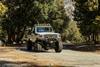
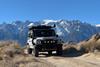
We liked the Jimny’s original Grove Green Metallic paint, but it showed its age. To freshen up the exterior, we turned to Texas-based XPEL, which had a new color solution: XPEL COLOR paint protection film (PPF). The PPF came in several colors, but we loved Moss Green, and chose that for the Jimny’s new hue.
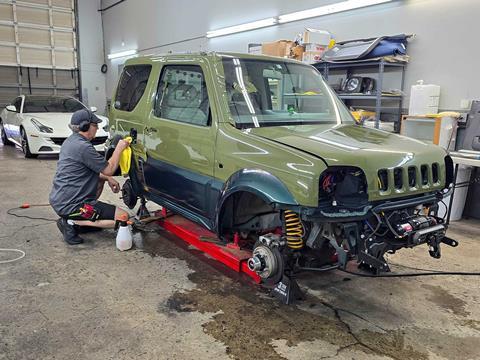
We also used XPEL ARMOR Textured PPF on the Jimny’s rocker panels, which provides a beefy textured black surface that helps guard against gravel rash.
Lastly, we opted to protect our windscreen from rock chips and other road hazards by wrapping it with XPEL Windshield Protection Film. This was especially important as a replacement windscreen is only available from overseas.
We had the wrap done at Portland’s Roadrunner Protective Films, where master installer, Dave Ball, worked his magic. After a few days, Dave had meticulously wrapped the 4x4.
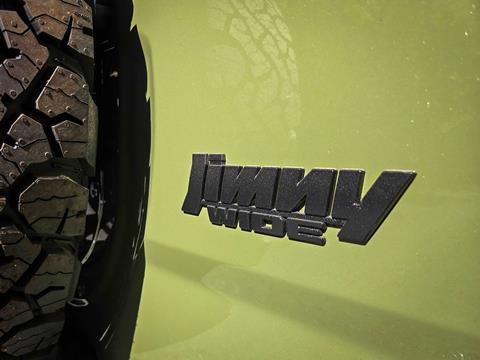
You’d be hard-pressed to know the PPF wasn’t paint. Speaking of, he painted the Jimny’s badges and tailgate’s hinges black resulting in a surprisingly modern look.
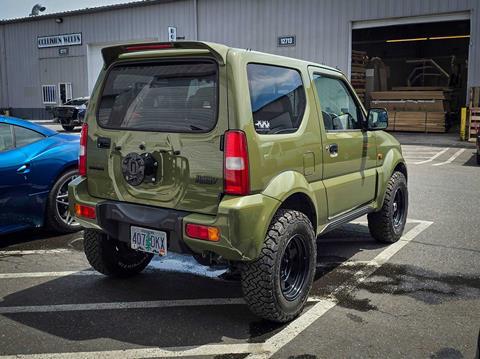
After the wrap job, we took the Jimny to the 2026 Northwest Overland Rally, it’s first longer distance trip and official post-build debut. There, onlookers couldn’t believe it wasn’t painted and that it was a 28 year-old rig!
FYI, we’ve left the interior alone sans a Quad Lock phone mount and replaced the dead speakers and JDM head unit with new equipment.
What’s It Like To Drive?
Driving a Jimny is a blast. We rented the current fourth-gen Jimny in Iceland in 2019, and they drive similarly.
A third-gen Jimny feels miniscule on US roads. However, it has very short gears, making it a ton of fun around town. It’s like a 4WD go-kart on rural roads and trails.
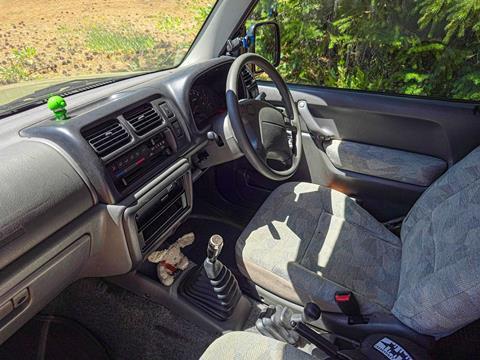
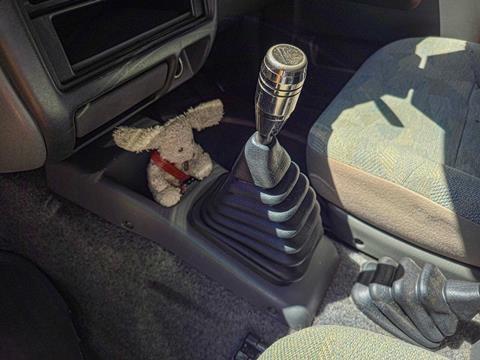
Ours is a five-speed manual, and the shifter is surprisingly good. The thing weighs about 2,500 lbs. and is exceptionally maneuverable.
Power under 50 MPH isn’t bad; in fact, it’s rather zippy. Merging onto the highway takes considerable planning, however. It’s happiest at cruising at 60 MPH, but 65 isn’t an issue. It will go faster, but it’s not enthusiastic about it.
We’ve used low range a few times thus far, and it works as advertised, providing slow, controlled driving. Our third-gen Jimny has loads of off-road potential, but we’re waiting to run more difficult trails until we get rock sliders for it. (We’ve learned that lesson, dented rocker panels and all.)
Future Jimny Work + Trips
We still have work to do on the Jimny, such as adding those rock sliders. We also have some light mounts to install a set of LED lights and want to install mud flaps to protect the XPEL wrap job from gravel rash.
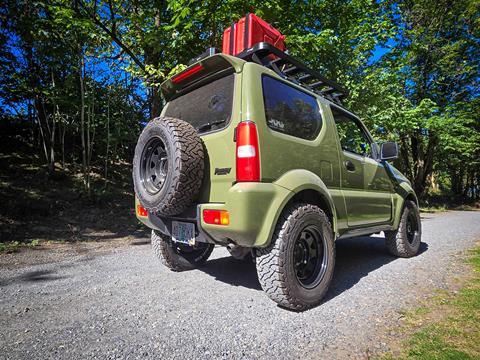
We have a host of trips and trails we’d like to do in our Suzuki. Some are long distances; some are local trails. This mighty but mini thing is just so much darn fun in every respect. It’s cute, capable, and frugal and gets lots of looks.
We’re looking forward to making more miles and memories with the Jimny. Stay tuned to see what happens next with our pint-sized Japanese Jimny.
Access More Great Stories!
For more informative articles like this, consider subscribing to OVR Magazine in print or digital versions here. You can also find the print edition of OVR at your local newsstand by using our Magazine Finder.


No comments yet